Chapter 10
Canard Construction
The canard is the name given to the small wing at the front of the Cozy Mark IV. It is used to create lift like the main wing and also incorporates the elevators which are used to cause the aircraft to pitch up and down. In a properly designed canard configured aircraft, it also helps create stability and resistance to stalling. Not to say that the aircraft cannot be stalled. The canard's airfoil shape is a RM1145S designed by John Roncz. The canard was first used on the Long-EZ designs as they were susceptible to pitch changes in rain. This airfoil does not exhibit pitch change in rain.
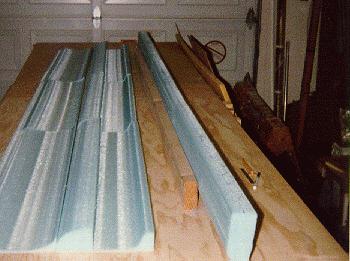
To begin construction of the canard, you "hot wire" blocks of Styrofoam to the airfoil shape. This is done by making templates which are attached to the ends of the properly sized foam blocks. Using a hot wire cutter (essentially a small diameter, stainless steel or nichrome wire that has electrical current flowing through it to heat it up) you trace the outline of the templates with the wire through the foam. When you are done you have perfectly shaped pieces of foam ready to prepare for fiberglass. OK, so maybe they aren't "perfect" - hot wiring takes some skill and coordination to get it right. After cutting the foam cores to shape, the leading edge of the airfoil is cut off so that the shear web can be glassed on. I have a picture which shows the shear web core ready to glass with some of the foam cutoffs off to the side.
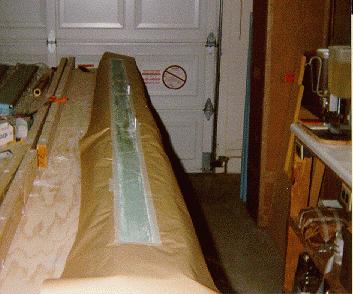
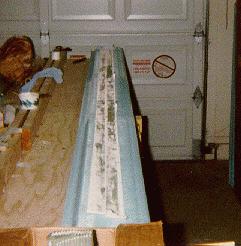
After glassing the shear web, two lift tabs are installed near the middle of the canard. These will be the main attach points of the canard to the fuselage, so it is important that they are installed correctly and straight. Next, the leading edge is bonded back onto the shear web. The canard is then turned with the lower side up and masked off in order to lay in the bottom spar. During the hot wiring phase, the canard cores had troughs cut into them to allow for the addition of the spar caps. The fiberglass used for the spars is about 4 inches wide and runs in one direction - lengthwise along the canard. Many layers are used and gradually taper off toward the outboard edge of the canard. The center of the canard has a substantial thickness of spar cap. Here are some pictures of the canard masked off ready for the spar lay-up and after the masking paper is pulled away. The white shiny stuff on the spar is peal ply.
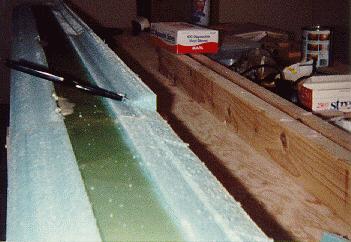
The bottom canard skin is then laid up as specified and allowed to cure. Then the canard is turned over and the top spar cap is applied just like the bottom spar. Prior to laying up the top skin, the "fishtail" is removed with a blade of some sort (I used a hacksaw blade) and the surface of the foam is contoured to the correct airfoil shape. The fishtail is a section of foam that is built into the cores to aid in laying up the bottom surface and aft end of the airfoil. Once it is removed, bare fiberglass is exposed at the aft end of the canard which is bonded directly to when the top skin is laid on. Also, prior to laying up the skin, small areas of dense foam are inserted into the canard where the elevator hinges will be mounted. The dense foam allows for better adhesion to the metal hinges than the Styrofoam. Here's a picture of the fishtail being cut off.
After glassing the top skin, the canard is trimmed at the aft end and stored temporarily while the elevators are constructed in chapter 11.